









Meteorite Information Page
The following will try to give a tangible, yet brief explanation of many things meteoritic. This is a new section in our web site and it is currently under construction. The field of meteoritics is quite vast and there are many excellent books and videos available from many outstanding researchers and authors. I will start with a brief explanation of the different kinds of meteorites. Following that you will find a few definitions that I will present that should help the reader to understand the information presented on meteorites in these pages. Italicized words indicate that they are explained in our dictionary section, which will continue to grow as time allows.. We hope to have plenty of thumbnail images to help give the visual element to our explanations. If there please just click on the image to see if we have attached a link to get a larger picture on your screen. When studying meteorites please bear in mind that this is a science that is still defining itself and new discoveries often occur which do not always seem to fit into the simplified classification schemes that are in use today. Only through continued study will this system be refined and, hopefully, lead us to a better understanding of this little corner of the universe we call home. Please contact us with any suggestions as to how we can improve this page or make it easier to navigate and take in.
What are Meteorites?
Meteorites are remnants of the material that formed our solar system and have survived the trip through our atmosphere to arrive on the surface of our planet. Approximately four and a half billion years ago the material that was to build our solar system came into being. The first of the elements that we know on the periodic table of elements formed in the core of a star that existed here before our sun came into being. Then when that star went super nova the remaining heavier elements were formed. Over time many these individual grains began to bump into one and other forming ever larger masses. This process continued until much of the material was in the form of larger asteroidal or planetary bodies.... many of which still survive today... such as this little chunk of rock we call home. Over time many of these objects collided as can be seen by the abundant impact craters on our neighboring planets and moons, not to mention the growing number of identifiable craters on our planet as well. They are harder to see on the earth due to the vigorous geologic processes that continually modify the surface of the planet but there are plenty crater structures still recognizable. Many of these impacts led to shattered planetoids which in turn increase the amount of material drifting around to make new craters on any world that happens to get in its way. Over the past ~4.5 billion years most of the debris has been cleared out by the orbiting planets and their moons however there is a great deal of debris in between the orbits of Venus and Jupiter. It is thought that this debris may be the remains of a failed planet or it could just be material enough for a planet that cannot form due to the disruptive gravitational pull from Jupiter. Beyond the orbit of Pluto there is another area that is known to contain a great deal of unincorporated debris. This is called the "Oort cloud" and is where comets are thought to originate from. When the objects in either of these belt areas are affected by collisions or the affects of gravitational forces their orbit may be altered enough to send them traveling through the inner solar system. Meteorites are very important to science in that by examining them we are able to (in many cases) view the very stuff that came to be our solar system. All the rock on earth (while starting out as the same material as meteorites) has been reprocessed by the active geological forces here to the point that it has no resemblance to the original material. At the end of 1999 there were 22,507 known meteorites. All meteorite names must be approved by the Meteoritical Society and names will reflect the nearest geographical location to the find or fall.. if at all possible. If the exact location is not known they will be assigned a regional name and a number indicating the order in which it was found in the particular area. Examples of this would be the NWA (Northwest Africa) meteorites from Morocco and Algeria or the Sahara meteorites from the desert regions of Libya and Egypt.
Types of Meteorites
In the simplest break down there are three types of meteorites: STONE, IRON and STONY IRONS.
Stones: Is pretty self explanatory, they consist almost entirely of stony mineral components. This would be chondrules and the dust of crushed chondrules and any other solar (or rarely interstellar) mineral grains that happen to have been in the area when all the material combined to form the parent asteroid or planetoid or meteoroid. Also commonly found in stone chondrites are small grains of "metal" which are a mineral of iron and nickel (Fe Ì Ni). Testing for the nickel is one of the main ways that meteorites are confirmed to actually be meteorites. While most of the meteorites in this class are called "common or ordinary chondrites" and are further broken down in to "L" (low iron) chondrites, "H" (high iron) chondrites and "LL" (low iron metal & low total iron) amphoterites. There are several, less common, types of chondrites such as "C" (carbonaceous) chondrites, "R" (Rumarutiites) chondrites and "E" (enstatites) chondrites. In addition to this there are a small percentage of stony meteorites that are quite unusual. For more information (and many images) on the various types of chondrites please look in the "Glossary of Terms" section below. These are called "Achondrites" since the chondrules are no longer visible due to their having formed from a melt. There are numerous classes of Achondrites and we will try to get them listed in these pages as soon as we can. These have undergone great change since their formation and where at some point incorporated into a larger "parent body" such as a planet, moon or larger asteroid. While on these parent bodies they were subject to varying degrees of heating and compression either from radioactive decay of the elements, deep burial or impacts or any combination of these events. These meteorites are highly prized by scientists and collectors as they give clues into the geologic processes that have affected the other planets and moons (and large asteroids) in our solar system. A rare few of the meteorites recovered have been identified as having originated on the Moon or the planet Mars.
Irons: The iron meteorites are formed on parent bodies that undergo enough heating to cause the iron grains to melt and migrate to the center because of gravity. This is the same way that our earth got its core, which is also made up of iron-nickel. The iron meteorites are "liberated" when there is some sort of catastrophic event, most likely collisions with other parent bodies, which exposes the iron core to space. It subsequently cools and may become a large iron asteroid like we have seen in the movies or it could be in the form of many smaller "chunks" that could be future meteors or meteorites. The irons are divided into 3 main types: hexahedrites less than 6% Ni), octahedrites, which are the most common (6- 16% Ni), and ataxites (more than 16% Ni). The differences being in the amount of nickel and other volatiles present. When the octahedrites are polished and etched with acid they reveal what the internal crystal structure looks like as the widmanstatten patterns become visible.
Stony-irons: As the name implies these are made up of a combination of iron and stony material. The stony irons seem to be the remains of many violent events which occurred early on during the formation of our solar system. They appear to have formed during collisions of large objects that caused melting or the upwelling of molten material. This would explain the metal (Fe-Ni) being intermixed with such a wide variety of other lithologies that you would not normally find with molten metal. The stony irons consist of various sub-types such as mesosoderites, pallasites, silicated irons.
Glossary of Terms
Ablation: As an object enters our atmosphere it experiences extreme heating to its surfaces which in turn causes a portion of the object to melt or be vaporized. This loss of material is called "ablation".
Acapulcoite: This class of meteorites are very rare and represent a class of primitive achondrites that have experienced a moderate degree of melting and recrystalization. Lots of visible metal grains as well.
Accretion: The process by which dust, individual grains, and chondrules are accumulated through contact with other objects in space leading to the formation of meteoroids, asteroids and planetoids.
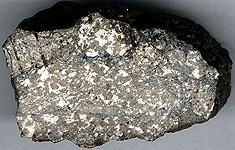
Achondrite: Is a meteorite in which chondrules are not visible. These have undergone extensive change due to re-melting of the original chondritic material from the heat of radioactive decay, burial or impacts or any combination these events. That being the case means that this class of meteorites are formed from the complete melting or partial melting of the original chondritic material. If any of the rocks from our planet were to make it into space to become meteoroids this is the class they would fall into. The following is a list of the different classes of achondrites, for more detailed information on each class please read below. The 14 classes are: Acapulcoite, Angrites, Aubrites, Brachinites, Diogenites, Eucrites, Howardites, Lodranites, Lunar, SNC (Martian), Ureilites, Winonaites, Ungrouped and Unclassified. The image below is a cumulate eucrite (Dhofar 007)
Amphoterite: Refers to the "LL" class of meteorites. Please go to the "LL chondrite" definition below for more information.
Angrite: These meteorites indicate that they crystallized from a melt of basaltic composition. Their formation ages are also very old at ~4.56 billion years. This age means that they were formed in the very early stages of the formation of our solar system.
Anhedral: Refers to mineral grains that do not have clearly defined crystal faces.
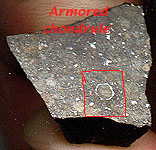
Armored chondrule: This is the term used to describe a chondrule that is entirely ringed (encircled) in metalic iron. The image below is of an easily discernible armored chondrule from the Gold Basin, Arizona L4.
Asteroid: A large body of stone or iron (or both) that is not in orbit around a particular planet or moon.
Asteroid belt: The debris filled area between Mars and Jupiter containing enough material to make up one or more planets. This is where most of the meteoritic material that reaches the earth is believed to originate.
Astrobleme: This term is basically referring to a large crater structure except that it is very ancient and may be almost indistinguishable on the surface. Often it takes a closer examination of the rocks in and around the structure to see if they exibit any signs of the high shock that would be associated with a large impact event.
Ataxite: Class of iron meteorite with no widmanstatten pattern and they consist of more than 16% nickel.
Aubrite: Are also melt created and contain large crystals of enstatite. The aubrites are almost always brecciated and have a close association with the enstatite chondrites. It is believed that they formed in the same inner part of the solar system as well.
Basalt: This is volcanic rock that has flowed to the surface. This is generally very fine grained material that consists mainly of pyroxene and plagioclase feldspar and minor accessory minerals. Many of the lunar and martian meteorites are also basaltic in origin.
Brachinite: These primitive achondrites are olivine rich meteorites and are very ancient at ~4.5 billion years old.
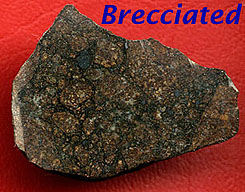
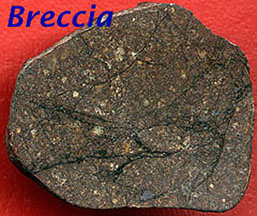
Brecciated: A rock that consists of broken angular fragments set in a finer grained matrix made up of the same material. The slices below are form of the newer Saharan L6's fond in 1999.
Bronzite: This is a magnesium (Mg,FeSiO3) rich orthopyroxene common in stone chondrites.
CAI: This stands for "calcium-aluminum inclusion" or in normal english... it refers to irregular shaped mineral inclusions (whitish-grey in color) with calcium and aluminum as the primary elements. These CAI's are unusual in that they are thought to originate from some "extra-solar" source. The inclusions pictured below are from the Allende CV3 carbonaceous chondrite.
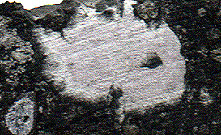
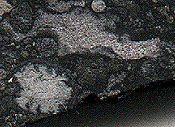
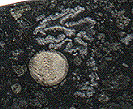
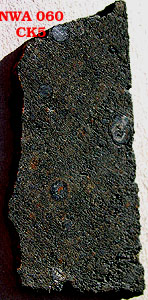
Carbonaceous chondrite: These meteorites are notable because they have a higher percentage of carbon than the ordinary chondrites. Many carbonaceous chondrites also show signs of alterations by liquid water. It is also thought that this class of meteorite represents material from cometary objects. Since there is a wide variety within the mineral types of the carbonaceous chondrites they have incorporated a second letter into the naming process. This second letter stands for the "type location" of the different varieties. This leads to the following CV (Vigarano), CM (Mighei), CR (Renazzo), CK (Karoonda), CI (Ivuna), CO (Ornans) and a newer CH class with the "H" meaning high iron. The carbonaceous meteorites will have petrologic types ranging from 1 to 3. In this case the "3" indicates very little alteration to the chondrules present... just like in the other chondrites. But this is where the big difference comes from, the number "2" will indicate chondrules that are a bit less distinct due to alteration processes that have apparently included interaction with liquid water.... yes liquid water (at <20 degrees C.). The "1" type chondrites were exposed to water that reached temperatures as high as 50 degrees C.
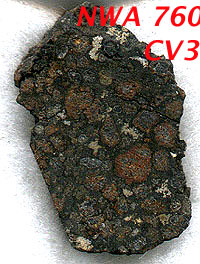
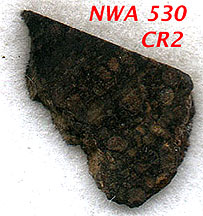
Chassignite: The Chassignites represent the "C" in the SNC Martian meteorites and consist almost entirely of olivine.
Chondrite: Is a meteorite in which one of the identifiable components are chondrules. They may be readily visible in a cut surface or they may have been altered to such a degree that they are almost impossible to recognize with the naked eye.
Chondrule: These are small spheres that were formed by the melting of mineral grains in the solar nebula. The exact means of heating that caused the melting is still a point of much discussion. Some chondrules are made up of just one mineral or they may consist of more than one mineral. The interior textures will vary greatly depending on what types of heating and/or impacts that have affected the chondrule after its formation. These may be several millimeters in size or they may be almost microscopic in size. Image on the left is Parnallee (LL3) and on the right is Begaa (LL3).
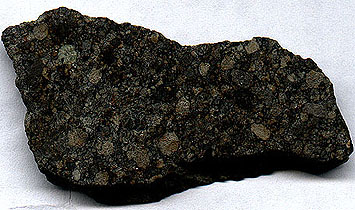
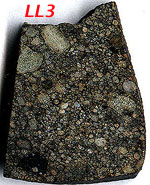
Coesite: A high pressure form of quartz that is associated with impact structures. In thin section the quartz crystals exibit an undulatory texture when rotated on the viewing stage.
Cohenite: This is an iron carbide (Fe,Ni,Co)3C accessory mineral that occurs in iron meteorites.
Complete Slice: This would be an entire slice from a complete, individual meteorite NOT from an individual fragment. There would be cut surfaces on the front and back with non-broken edges.
Corner Cut: This would mean that an "end cut" has been cut in half. There would be 2 cut surfaces (at ~90 degree angle) with the rear of the specimen being either crusted or broken surface, or some combination of the two.
Cosmic Velocity: This is the speed of an object passing through space and is usually measured in kilometers per second.
Crater:
This is the "hole" punched into the surface of a planet, moon or
asteroid by the impact of a meteorite. They can be microscopic in size or
they can be hundreds of kilometers across.
Cumulate:
A cumulate is a rock formed in an igneous environment where crystals form
from a melt and sink due to the effect of gravity.
Differentiation: The seperation of different mineral componants from a molten or partially molton source.
Diogenite: This class represents material that cooled very slowly from magma which allows for large crystal growth. They consist mainly of orthopyroxene with a bit of olivine and plagioclase feldspar. This would also indicate that they formed at some depth.
End Cut: This is the first or final cut from a specimen. there will be one cut surface and the rest will either be crust or broken surface, or a combination of both.
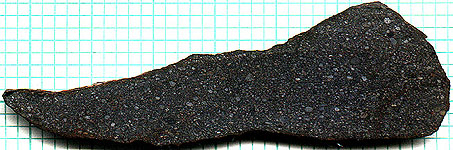
Enstatite chondrite: This is the "E" type chondrite, a class of meteorite with a very low oxygen content. The enstatite chondrites are also divided into "H" and "L" componants based on the amount of total iron present. The "EH" class contain 25% or more of iron while the "EL" contains ~25% or less total iron. This has led to speculation that they formed in an area much closer to the sun and possibly within the orbit of the planet Mercury and the Sun. The specimen pictured below is an EH3 (Sahara 97103).
Equilibrium: This is a state when the minerals present are stable for the current conditions and are not experiencing any chemical changes to their composition.
Eucrite: These are meteorites that resemble basaltic material found on earth. The are made up of crystals of plagioclase and pigeonite.
Euhedral: Is the term used to describe a mineral grain with very clearly defined crystal faces.
Fall: A meteorite fall is when a meteorite is witnessed to fall and is retrieved shortly thereafter. Falls are notable for the fresh crust and highly prized by scientists as they get an opportunity to examine an object that dates back billions of years (~4.6 billion years in most cases) into the very beginnings of our solar system.
Fallback Breccia: This is a brecciated rock made up from material thrown up into the air by a large meteorite impact that falls back into and around the crater that was created from the impact.
Fayalite: Fayalite (Fe2SiO4) is the iron (Fe) rich end member of the magnesium (Mg) - iron (Fe) solid solution series for olivine.
Feldspar: While the family of feldspar minerals are very common and abundant on earth they are much less common in meteorites. In stony and stony-iron meteorites they may constitute 5% to 10% of the total weight. The feldspars also make up a a group of minerals from a solid solution series with the Na (sodium) rich plagioclase (NaAlSi3O8-CaAl2Si2O8) feldspar being most common in the stone chondrites. In the differentiated achondrites the feldspars get richer in Ca (calcium).
Find: A meteorite find is a meteorite that was discovered in the field but was not seen to fall. They may have been there a few years or they may have been there thousands of years.
Forsterite: Forsterite (Mg2SiO4) is the magnesium (Mg) rich end member of the magnesium (Mg) - iron (Fe) solid solution series for olivine.
Fragment: A fragment is a specimen that has no cut surfaces and is not a complete, individual meteorite.
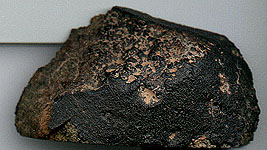
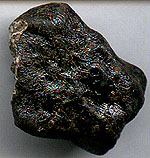
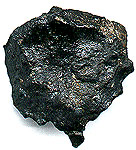
Fusion crust: The melted glassy looking surface of a meteorite the is formed by its passage through our atmosphere at cosmic velocity. Pictured below is NWA 531 (LL4) on the left and Camel Donga (AEUC) in the middle and Lowicz (MES) on the right. Note the textural differences in the crust between the chondrite, achondrite and the stony iron.
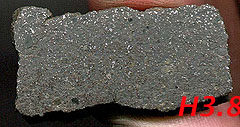
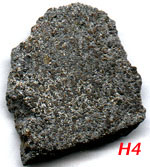
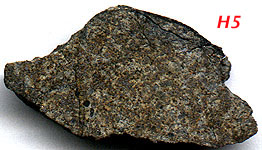
H-chondrite: In this mineral type of chondrites the "H" stands for high iron content. Between 10% and 20% of the total weight will be in the form of metalic iron, and if the iron that is in the stone minerals present is added in the total weight percent of iron can approach 40%. These meteorites will also be assigned a numerical number "petrologic type" which is based on the amount of alteration the specimen has undergone. These "types" are numeric and range from 3 to 7 with a "3" being the least altered, or in meteoritical terms, unequilibriated. In simple terms it means that a type 3 will have beautiful round chondrules that look much as they did when the were incorporated into the meteorite. On the other hand, a type 7 would be so altered, either by heat, pressure or what ever, that you would not be able to discern any distinct chondrules. Sooo.. to clarify with a couple of examples: An "H3" would be a stone meteorite with "high iron content" and be of petrolgic type "3" meaning the chondrules are easily visibly in the specimen. An "H6" would also be a stone meteorite with "high iron content" but since the petrologic type is "6" the chondrules would be altered in shape and/or composition making it almost impossible to see except under very close inspection. Pictured below from left to right are: NWA 532 (H3.8), Ochansk (H4) and Jilin (H5).
H-E-D: Refers to the Howardite, Eucrite and Diogenite classes of meteorites. Please refer to individual descriptions.
Hexahedrite: Class of iron meteorite with widmanstatten bands that are greater than 50 mm in width and consist of 4.5 Ì 6.5% nickel. It should be noted that the widmanstatten bands are so wide that unless a very large specimen is being etched the pattern may not be visible.
Howardite: These are interesting in that they contain fragments of both eucrites and diogenites and are thought to have been formed on the surface (regolith) of a parent body. The impacts on the surface would fragment and mix the various types of material which would eventually consolidate to form the howardite type meteorites. Another way to look at it would be the dirt on the surface of a small planet.
Hypersthene: This is a magnesium (Mg) rich pyroxene (Mg,Fe)SiO3 that is common in stone chondrites.
Impactite: An impactite can take many forms. It may be any of the commonly known tektites such as Indochinite, Moldavite, Libyan Desert glass, or Darwin glass or it may refer to the other mineralogic evidence of an impact event. Some of this other material would be fall back debris or shatter cone structures.
Impact Melt: This is rock formed from the material that was liquified from the heat generated by a large meteorite or asteroid impact. Impact melts will often have vesicles (small air pockets) in them similar to what can be found in some terrestrial basalts.
Individual: This would refer to a complete meteorite that has not fragmented upon its passage through our atmosphere.
Iron: Refers to the class of meteorites made of almost entirely of iron. Nickel is also a very common component of most iron meteorites and is one of the indicators looked for when testing a specimen to see if it is in deed a meteorite. It is important to note that there are some types of iron meteorites that contain little or no nickel. In addition to the iron (Fe) and nickel (Ni) there are many other accessory minerals that may be present in variable amounts.
Kamacite: Kamacite is one of the 2 primary nickel-iron alloys commonly found in iron meteorites. Kamacite has a nickel content 7.5% or less.
K-chondrite: The "K" stands for Kakangari and this small group of chondrites exhibits a chemical oxidation state that falls between the enstatite chondrites and the ordinary chondrites.
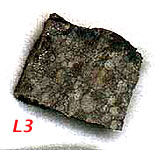
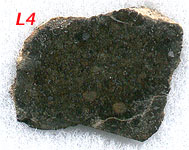
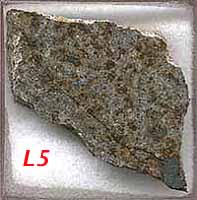
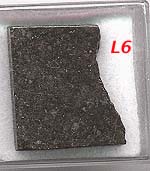
L-chondrite: In this mineral type of chondrites the "L" stands for low iron content. Between 5% and 10% of the total weight will be in the form of metalic iron, and if the iron that is in the stone minerals present is added in the total weight percent of iron can range from 20-25%. These meteorites will also be assigned a numerical number "petrologic type" which is based on the amount of alteration the specimen has undergone. These "types" are numeric and range from 3 to 7 with a "3" being the least altered, or in meteoritical terms, unequilibriated. In simple terms it means that a type 3 will have beautiful round chondrules that look much as they did when the were incorporated into the meteorite. On the other hand, a type 7 would be so altered, either by heat, pressure or what ever, that you would not be able to discern any distinct chondrules. Sooo.. To clarify with a couple of examples: An "L3" would be a stone meteorite with "low iron content" and be of petrolgic type "3" meaning the chondrules are easily visibly in the specimen. An "L6" would also be a stone meteorite with "low iron content" but since the petrologic type is "6" the chondrules would be altered in shape and/or composition making it almost impossible to see except under very close inspection. Pictured below, from left to right are: Barratta (L3), Gold Basin (L4), Bechar (L5), and Sahara 98052 (L6).
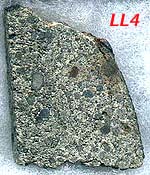
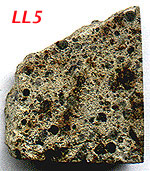
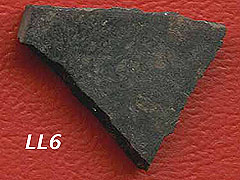
LL-Chondrite: In this mineral type of chondrites the "LL" stands for low iron AND low total metal content. There will only be between 0.3% to 3% of the total weight in the form of metalic iron. The total iron content will be within a few percentage points of 20%. Meteorites in this class may be referred to as amphoterites, as they were in the past, however the "LL" designation is considered to be correct. These meteorites will also be assigned a numerical number "petrologic type" which is based on the amount of alteration the specimen has undergone. These "types" are numeric and range from 3 to 7 with a "3" being the least altered, or in meteoritical terms, unequilibriated. In simple terms it means that a type 3 will have beautiful round chondrules that look much as they did when the were incorporated into the meteorite. On the other hand, a type 7 would be so altered, either by heat, pressure or what ever, that you would not be able to discern any distinct chondrules. Sooo.. To clarify with a couple of examples: An "LL3" would (absolutely gorgeous!) be a stone meteorite with "low total iron AND low total metal" content and be of petrolgic type "3" meaning the chondrules are easily visibly in the specimen. An "LL6" would also be a stone meteorite with "low total iron AND low metal content" but since the petrologic type is "6" the chondrules would be altered in shape and/or composition making it almost impossible to see except under very close inspection. Sorry if you've found these examples repetitive but they are listed under each of the chondrite definitions in the event someone were to only be looking up one definition. On the bright side... if you've read through all three of these chondrite definitions in quick succession then you probably have a great handle on the way the chondrites are classified!!! Pictured below from left to right are: Begaa (LL3), NWA 531 (LL4), Tuxtuac (LL5), and Hope Creek (LL6).
Lodranite: The lodranites (like the acapulcoites) are unique in that they are achondrites that are very similar to chondrites when you look at their composition. Both were formed from the partial melting of a chondritic mixture.
Lunar: Just as the name implies this class is represented by meteorites that originated on our moon. These have igneous formed anorthosite clasts, basaltic material as well as fine particles of glass and other shattered mineral grains This is perhaps the rarest and most sought after class of meteorites.
Magnetite: A shiny black iron mineral (fe3O4) often found in fusion crust and in carbonaceous chondrites.
Matrix: The fine grained material found in between the chondrules, fragments and metal grains found inside stone meteorites.
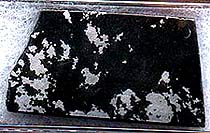
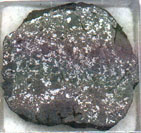
Mesosiderite: This class is composed of a mix of iron-nickel, silicate minerals and sometimes eucritic material. They very often indicate that they were created by some catastrophic event that brought all these elements together. The specimens shown below are (from left to right) Lowicz, Vaca Muerta and Sahara 98448.
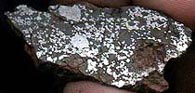
Meteor Is almost always what you see make a brief streak across the sky at night and make a wish on. These little visitors never make it to the ground but just vaporize upon making contact with our atmosphere. If one were to make it to the ground it would no longer be a meteor but would become an official meteorite.
Meteor shower: When the earth's orbit passes through the debris left behind from the comets that ocassionally pass through our solar system. These smaller than dust sized particles make for a beautiful show if you are ever fortunate enough to witness such an event. While making a brilliant flash as they streak across the night sky these little cosmic visitors burn up on contact with our atmosphere and never reach the surface of our planet.
Meteoroid: Is an object (either stone or iron or some mixture of the two) that is still floating around in space and has not come close enough to any other body (like a planet or a moon) to decide if it's going to be a meteorite or a meteoroid.
Meteoritaholic: Is what you are or may become if you are reading this or if you are beginning to discover an interest to collect meteorites.
Meteoritics: The study of meteorites and related items. This involves the fields of astronomy, chemistry, geology, physics and I'm sure a few others.
Meteorite: An object from space (not man made!) that makes it through our atmosphere and lands on earth (or any other planet, moon or asteroid). Meteorites are made up almost entirely of material that formed in our solar system when a prior star (to our sun) went super nova and helped to create the elements that make up the Periodic Table of Elements.
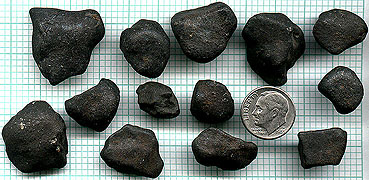
Meteorite shower: A meteorite shower occurs when one or more large objects enter our atmosphere and then fragment into many smaller pieces. This may occur high in the atmosphere which would allow each small fragment to have its own fiery trail... making it look as though the sky was raining fire. A rather startling experience for our distant ancestors I would imagine. In a shower the meteorites will land along a path of the earth under their re-entry point, this area is called a strewn field. The meteorite shower in Pultusk, Poland occurred in 1868 and is one of the best documented showers as hundreds of thousands of tiny stones fell on the startled people below. The image below shows 13 of these beautifully crusted little individuals that have come to be called "peas" due to their small size.
Micro-meteorite: A small grain sized meteorite which can only be positively identified under magnification.
Monomict: A texture composed of rock fragments of uniform composition.
Nakhlite: This is the "N" in SNC which refers to the 3 types of known Martian meteorites. Nakhlites are made up almost entirely of olivine and augite.
Neumann Lines: These are linear structures running along the crystal boundries of some highly shocked iron meteorites.
NWA: This is the prefix assigned to meteorites bought in Morocco and Algeria where the exact "find" location is not known. NWA stands for North West Africa.
Octahedrite: Is a class of iron meteorites that consists of numerous types that are determined by the width of the widmanstatten bands and the nickel (Ni) content. These classifications are as follows with the 1st number being the band width in millimeters and the second number is the Ni percent: Plessitic 0.1 -0.2mm and 13-17%; Finest less than 0.2mm and 7.8 -12.7%; Fine 02-0.5mm and 7.8-12.7%, Medium 0.5 -1.3mm and 7.4-10.3%; Coarse 1.3 -3.3mm and 6.5 -7.2%; Coarsest 3.3 -50mm and 6.5-7.2%.
Olivine: An iron-magnesium silicate that forms a solid solution series of minerals with forsterite being the Mg rich end member (Mg2SiO4) and fayalite being the Fe (iron) rich end member (Fe2SiO4). Olivines in meteorites are most often Mg (magnesium) rich where fayalite will comprise 15% to 30% of the olivine present.
Oort cloud: A highly populated area of cometary bodies that circle the sun beyond the orbit of Pluto.
Ordinary Chondrites: These are the most common stone chondrites which in most all cases contain chondrules. These would be the enstatite (E), high iron (H), low iron (L) and low metal, low total iron (LL) meteorites.
Oriented: This is a term applied to some meteorites that pass through our atmosphere without tumbling during their flight. This tends to give them a unique shape on the leading edge with regmaglypts only developing on the rear of the object. This type of entry can also lead to the formation of "flow lines" in the fusion crust.
Paired: This is a term applied to two or more meteorites that have different names or numbers which are determined to be from the same fall.
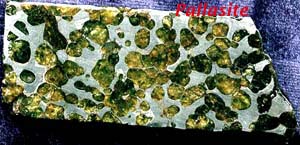
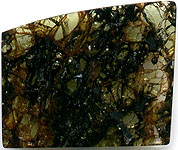
Pallasite: These are made up of iron-nickel intermixed with olivine crystals. The exact method of formation is not clearly understood at this time. The image on the left is acing slab of the Brenham Kansas pallasite, and the image to the right is a nice translucent specimen of the Esquel pallasite.
Parent Body: Would be the Planet, moon or asteroid from which meteoritic material originates. Once separated from the parent body it would be considered a meteoroid and later on it may possibly become a meteorite or meteor if it should encounter another "parent body".
Part Slice: Is a sliced specimen with cut surfaces on the front and back and also has at least one edge that has a cut face as well.
Petrologic type: This refers to the numerical scale from 1 to 7 which indicates the degree of metamorphism that has occured to the minerals in a meteorite. The "3" type meteorites exhibit the least alteration and the type"7" indicates severe alteration. The types "1" and "2" are assigned to meteorites that have been altered hydrothermally (with water).
Plagioclase: Please see "feldspar".
Planetoid: This would be the term applied to a large asteroid that reached the size of several hundred kilometers in diameter through the process of accretion.
Polymict: Is the textural term applied to a rock made up of fragments of more than one mineralogic composition.
Porphyritic: This is a textural term and refers to a rock with larger crystals contained in a fine grained matrix. In the study of meteorites this term is often applied to individual chondrules being observed in thin section. In scientific papers discussing meteorite specimens in thin section it may be used in abreviations such as PO (porphyritic Olivine), PP (Porphyritic Pyroxene) or maybe POP (Porphyritic Olivine-Pyroxene).
Primitive achondrites: These are rocks that have undergone partial melting but have retained enough mineralogic information to determine the composition of the parent body.
Pyroxene: This is another common mineral found in meteorites that is part of an incomplete solid solution series between Mg (magnesium), Fe (iron), and Ca (calcium) silicates. Stone chondrites are named by which ever of the pyroxene components that is present. Most common are the Mg rich members (clinopyroxenes) such as enstatite (>95% Mg), bronzite (~82%-92% Mg), and hypersthene (~70% to 82% Mg). All other members of the pyroxene family are known as clinopyroxenes and are often found as minor accessory minerals in meteorites.
Quarter Cut: Would look the same as a corner-cut (described above) but this would imply that it is one quarter of an entire meteorite..
Radial Texture: This refers to a chondrule or mineral in thin section that displays a "radial" texture when the microscope stage is rotated in a clockwise or counter-clockwise direction.
Regmaglypt: This is an impression (resembling a finger print on soft clay) or impressions left on the surface of a meteorite formed due to surface melting during its passage through our atmosphere.
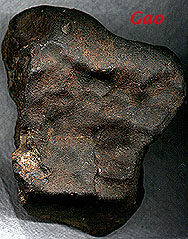
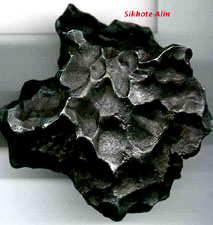
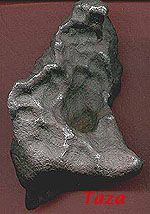
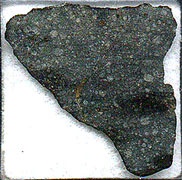
Rumuruti chondrite: This is one of the rarer classes with only a few finds/falls making up the class. These are the "R" chondrites and are notable for their highly oxidized iron and brecciated texture with lighter colored clasts in a darker matrix. Very few chondrules are present in comparison to the common chondrites. The specimen pictured below is from NWA 753 (R3.9).
Shergottite: The shergottites represent the "S" in the SNC class of Martian meteorites. Basaltic shergottite is made up of pigeonite, augite and plagioclase feldspar. lherzolitic shergottite is made up of olivine and pyroxene.
Silicated iron: This unusual class consists of iron-nickel mixed with silicate minerals such as pyroxene. The silicates may make up over 50% of these specimens.
SNC: This is the abbreviation given to a group of 3 types of meteorites which originate from the planet Mars. They are Shergottites (S), Nakhlites (N), and Chassignites (C). These are rocks that formed from a melt and depending on the depth of formation the crystal size will vary from one type to the next. Melts that cool quickly will have a short time for crystal growth leading to small crystal grains. Material that cools more slowly ( or being formed deep under ground) gives the crystals more time to grow...meaning bigger mineral grains.
Solar system: This is a term applied to material orbiting around a central star. In our solar system we have the four inner planets (Merury, Venus, Earth and Mars) consisting of mostly stone and iron componants, then the next four are the giant gas planets (Jupiter, Saturn, Neptune and Uranus) and the final planet is Pluto, a small frozen stone world that is usually the most distant planet from the sun. Our solar system also has the asteroid belt between the orbits of Mars and Jupiter where there is enough debris to make up another planet or two. And then beyond Pluto is the Oort cloud which is where the comets are thought to originate. In addition to that are all the moons that orbit the planets.
Stony iron: See mesosiderite.
Strewn Field: Refers to the recovery area of multiple fragments from the same meteorite, usually a long and narrow elipse. The general direction of flight can be determined from the size of the specimens recovered from a strewn field. The smaller pieces will fall to the earth first and the larger pieces will retain there velocity longer and accordingly they will travel farther... or to the down range end of the field.
Sub-hedral: Refers to mineral grains in which there may be some crystal faces visible.
Supernova: This is the term applied to a star that collapses inward upon itself generating an enormous explosion. This destructive event is where the heavier elements (above iron on the periodic table) are created by the shock wave from the explosion. The lighter elements (hydrogen thru iron on the periodic table) are formed in the interior of stars as they proceed through their life cycle.
Taenite: One of the 2 common nickel-iron alloys common to iron meteorites. Taenite has a nickel content of 20% or higher.
Thin
section: This is a very thin slice of a rock/mineral/meteorite
specimen (about 30 microns) that is mounted on a glass slide in order
to be observed under a microscope. This is one of the methods used in
determining the mineralogical make-up of a specimen. Also, by observing
the condition of the crystals one can get a minimal idea of what environmental
conditions the specimen has been exposed to.
Thumb Prints: See regmaglypt please.
Unequilibriated: Implies that there has been little change, or alteration (metamorhism), since formation of the material. As unequilibriated meteorites undergo mild metamorphism the creation of tiny feldspar grains from the chondrule glass is one of the first observable events. As the amount of feldspar increases the thermoluminescence also increases. This allows researches to assign incremental types between 3.0 and 3.9 based on the gradually rising degree of metamorphism experienced.
Ureilites: These are coarse grained meteorites which are made up of olivine and pyroxene with graphite or diamond present in the areas between grains. The formation of this class is still unresolved due to numerous factors.. one of which is the origin of the carbon. The diamond formation has been attributed to intense shock events.
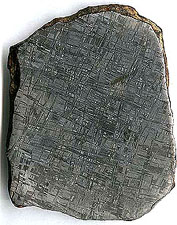
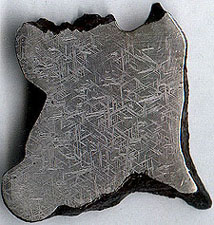
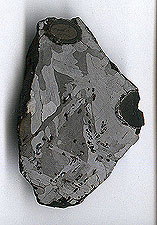
Widmanstatten: This is the pattern that is revealed when the surface of a polished iron meteorite specimen is etched with acid. Iron meteorites consist mainly of 2 iron-nickel (Fe-Ni) alloy minerals, Kamacite and Taenite. Though both are very similar minerals one has a higher percentage of nickel (Taenite) and as such it is a bit more resistant to the etching process which gives it a slightly raised pattern. This is what makes the wonderful crisscross patterns seen in many display specimens. The width of the Widmanstatten bands determines what type of octahedrite the specimen is. Below from left to right you will see a "fine octahedrite" (Gibeon), plessitic octahedrite (Taza), and a coarse octahedrite (Odessa). The Odessa specimen also contains 2 large inclusions, one of which is nicely zoned.
Winonaites: These are a group of primitive achondrites which are chemically very similar to the Group IAB and IIICD irons and are thought to be from the same parent body.
Unclassified: Means just that... they have not been officially examined or classed.
Ungrouped: This is a name assigned to a meteorite that does not fit into an existing class. If more are found that are chemically similar as time passes they may form a new class.
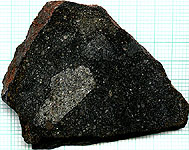
Xenolithic: Very similar to a Breccia except that some of the enclosed fragments are made up of material different from the matrix. The image below is from the Ghubara L5.
Home
What's New What
is a Meteorite? Meteorites
for Sale (Text Only) Purchase
Info
Micromounts Planetbrey
Collection Think
You've Found a Meteorite? Cool
Links
Email Planetbrey
If you have problems viewing this site, please email webmaster@planetbrey.com.
All
product prices, specifications, and availability are subject to change
without prior notice.
Not responsible for typographical errors.